
Beyond “Hard”: Exploring Cognitive Demand in STEM Classrooms

How is cognitively demanding different from hard, and why does that distinction matter? While hard tasks might take longer or feel more difficult, cognitively demanding tasks require more creative and complex reasoning. Thoughtfully designed and implemented tasks with high levels of cognitive demand increase learning, engagement, and retention while improving creativity and problem-solving skills.
What is cognitive demand?
Cognitive demand1 refers to the depth and nature of the thinking a task requires. When students engage in a cognitively demanding task, they are thinking independently and making sense of a problem themselves. The amount of cognitive demand in any particular task can vary. The actions teachers take also vary along a spectrum depending on the level of cognitive demand in a particular classroom task (Figure 1).
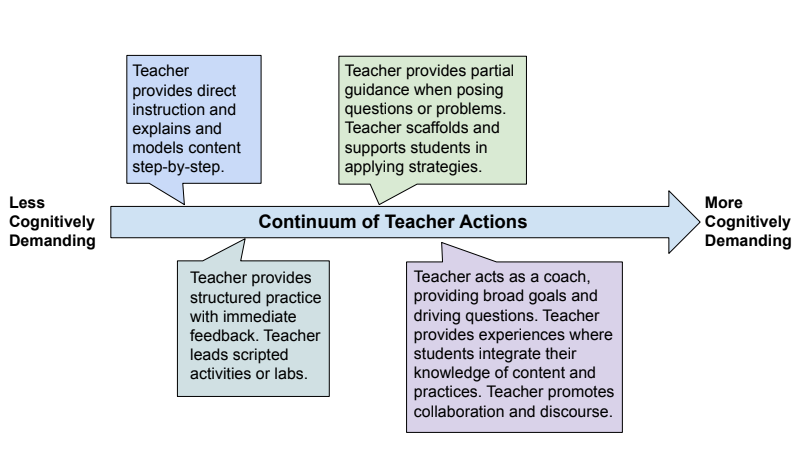
Figure 1: How teacher actions reflect the varying levels of cognitive demand along a spectrum.
Low-demand tasks ask students to recall, reproduce, or follow as they memorize, apply rules, and mimic procedures. Students operate like tourists following a map: all the landmarks are labeled, the route is drawn, and the only cognitive lift is staying on the path. Students are doing important work, just not particularly rigorous work.
Medium cognitive demand tasks require connecting ideas or applying concepts, but usually with some guidance or scaffolds. For example, students might interpret representations of data, engage with the “why” behind procedures, or apply a formula in a new context.
High-demand tasks require connecting different concepts (sense-making) and student-to-student discourse. They ask students to integrate, choose, design, justify, and revise. Students are the mapmakers. They decide which route makes sense, what tools to use, what assumptions matter, and how to justify the choices they make. They’re integrating concepts and practices the way professional mathematicians, scientists, and engineers do.
| Low Cognitive Demand | Medium Cognitive Demand | High Cognitive Demand | |
| What Students May Be Doing | Reproducing memorized vocabulary, facts, rules, or formulas
Matching or ordering Computations |
Following scripted actions to achieve a predetermined outcome
Engaging with conceptual ideas that underlie procedures Making connections between representations Using given formulas, algorithms, or prescribed steps Engaging with conceptual ideas that underlie procedures |
Making sense of a question or problem by integrating knowledge of content and practices
Making decisions about which practices or skills to use Accessing and applying prior knowledge and skills Self-monitoring and self-regulating Engaging in productive struggle Interpreting, extrapolating |
Figure 2: Excerpt of a chart describing how students participate in activities with varying levels of cognitive demand. For the full chart with more context and details, click here.
How are “hard” and “cognitively demanding” different?
The key difference between “hard” and “cognitively demanding” is that cognitive demand calls on students to work as sense-makers, not just task-completers. Students choose which content and practices to use. They reason through ambiguities. They test and refine their thinking. They generate explanations, not just answers.
A task might feel hard because it’s long, uses unfamiliar vocabulary, has unclear directions, requires background knowledge students don’t yet have, or expects precision under time pressure. While these qualities can make a task feel demanding, they do not require or promote meaningful thinking. Memorizing isolated formulas, grinding through repetitive steps, or interpreting opaque directions can be exhausting without offering conceptual payoff.
On the contrary, a beautifully designed high-demand task can feel much more accessible to students. Because high-cognitive-demand tasks have multiple entry points, students can approach them with whatever prior knowledge and skills they bring to the table. When tasks are accessible, students have something to make sense of and lean into what they are working on.
Why use cognitively demanding tasks?
Cognitively demanding tasks help students build durable understanding, navigate unfamiliar situations, make connections across topics, and develop independence and confidence. Used at the right time, they invite students to analyze, justify, apply, and create, while offering multiple entry points that support equity and access. Students find their place as part of an authentic and productive learning community, just as real scientists, mathematicians, and engineers do. When to use cognitively demanding tasks?
Cognitively demanding tasks are powerful, but they are not an everyday necessity and work best when used in balance. Like a well-designed workout plan, effective instruction varies levels of cognitive demand to build students’ thinking capacity over time. Low- and medium-demand tasks, such as warm-ups, retrieval practice, guided examples, and fluency work, are essential for helping students develop the foundational knowledge and familiarity they need. Without this groundwork, high-demand tasks can fall flat, leading to guesswork rather than productive struggle.
High cognitive demand tasks are most effective when the goal is deep understanding, reasoning, and sense-making. They are especially valuable for launching or extending learning, fostering discussion and collaboration, and serving as formative assessments that reveal how students think.
The real instructional impact comes from intentionally varying cognitive demand across a lesson or unit. Teachers should avoid relying on high-demand tasks for introducing new content without scaffolds, practicing procedures, reinforcing foundational skills, or working under tight time constraints. Instead, by sequencing tasks thoughtfully – moving from rehearsal and guided sense-making to rich, cognitively demanding work – teachers create conditions where students are ready to engage deeply and think meaningfully.
Why does it matter?
Cognitively demanding tasks give students access to work that matters. When math and science classrooms are designed around these tasks, students move beyond completing directions and begin engaging in the authentic intellectual practices of STEM: reasoning, modeling, questioning, testing, and justifying ideas. In these moments, students are not just learning math or science; they are doing it. Classrooms transform into communities of thinkers, and students begin to see themselves as mathematicians, scientists, and engineers.